
Press Release
How Super Intelligence (SI) Policy Helped Deliver Democrat Majorities & What the GOP Needs to Do to Recalibrate Ahead of 2028
Tuesday’s election results were a sobering reminder for conservatives of just how fragile our majorities are in Washington and in many GOP-led states across the country.
To: Interested Parties
From: Alliance for a Better Future
Date: November 4, 2026
RE: How Super Intelligence (SI) Policy Helped Deliver Democrat Majorities & What the GOP Needs to Do to Recalibrate Ahead of 2028
Tuesday’s election results were a sobering reminder for conservatives of just how fragile our majorities are in Washington and in many GOP-led states across the country. They also provide a case study for how quickly and decisively voters can turn against a party in power if they don’t believe policymakers are properly addressing their top concerns.
While most of the pundit class is attributing the major GOP losses earlier this week to the war in Iran, gas prices, and the overall state of the economy, it’s impossible to ignore the strong impact Super Intelligence (SI) policy had on this election and how connected it is to economic concerns in particular. In fact, the rise over the last year in voters who say SI will make their job obsolete, measured by Gallup, corresponds to the rise of SI’s salience on the issue grid measured by Navigator in a separate poll, which found SI had “the most significant growth of any issue” the pollster tested this year.
Every datapoint from the fundamentals of the political environment, to the pre-election polls, to the weight of message on the airwaves, points to SI’s outsized role in Tuesday’s results. This memo will shed light on how Democrats weaponized SI politics and makes the case for how we can best recalibrate as a party to ensure the issue is no longer a liability come 2028. In fact, if Republicans recalibrate correctly, SI can be an asset in 2028 for both our country and our Party.
A NOTE ON THE FUNDAMENTALS OF THE ELECTION
In any election where the economy and cost of living are top concerns, the party in power usually gets the blame. This time around was no different. What was unique to this cycle, however, is how economic concerns were paired with such a strong anti-elite populist sentiment that worked against Republicans. Not only did Democrats make the case that the GOP wasn’t delivering on the economy, they also spent over $173 million telling voters that corruption is a major reason why their economic needs are not being fulfilled. This deadly one-two punch meant the average swing voter went to the polls pessimistic about their financial security while believing elites in government and the business community were to blame. This dynamic also provides an explanation for how SI also emerged alongside the economy as one of the most potent issues of the cycle.
THE POLLING: AS VOTERS BECAME MORE CONCERNED WITH SI, THEY WANTED MORE FROM THE GOP ON SI SAFEGUARDS AND LOST TRUST IN THEM TO DELIVER
One of the dynamics ignored by political observers when considering SI’s importance in this week’s election is how the economic concerns are inseparable from concerns about SI.
- A nationwide survey released by ABC News on October 18 found that “More than six in 10 respondents said there is a high or very high risk that AI will eliminate many jobs.”
- A national survey released by Elon University on October 13 found that “83% of U.S. adults expect AI to eliminate more jobs than it creates, 68% expect most jobs to pay too little for a decent lifestyle and 62% expect most available jobs to be dull and unfulfilling. The threat reaches beyond income: 65% agree that if AI makes work less meaningful, people will lose their sense of purpose and dignity.”
- A national survey released by Gallup on September 15 found that “27% of U.S. workers, a new high, worry that technology could soon make their jobs obsolete. This is up seven percentage points from last year.”
These populist economic concerns are what drove SI’s ascent up the issue grid this year, a phenomenon that flew under the radar because it was so rapid.
- A nationwide survey released by CNBC on October 24 found “when asked their top concerns if Republicans retain Congress, 18% of voters in the survey cited a failure to regulate AI and data centers. That tied continued military efforts in Iran.”
- A nationwide survey released by Navigator Research on October 21 found that SI saw the “most significant growth of any issue tested this year” when they asked voters what should be top issue priorities for Congress and the President. The issue went from being named as important for 7% of voters to 21% (+14 net). No other issue tested (including inflation and the cost of living) rose by more than 4% in the same time span. *This 14 point jump also corresponds to the surge Gallup found in the same time period for those worried SI would make their jobs obsolete.*
Even more striking is how unified voters were in the lead up to the election in their belief that policymakers should address SI with more safeguards.
- A survey of 21 competitive House battleground districts released by Guidant on October 29 found that “eight in 10 voters (80%) say they would be more likely to support a congressional candidate who backs commonsense guardrails on artificial intelligence” while “two-thirds of voters (66%) would be less likely to support a candidate who opposes guardrails on the grounds that regulation would stifle innovation.”
- A survey of Ohio and Iowa voters from Inquire released on October 27 found that 67% of voters in both states say the U.S. should enact more reasonable safety measures even if it is not always first in the global SI race.
- A Senate battleground survey released by Cygnal on October 22 found that “64% say AI development should be addressed with more oversight.”
- The Navigator Research survey referenced above found “66% want more regulation of AI, up 6 points from 2025.”
- A national survey released by Reuters/Ipsos on October 7 found that “a bipartisan majority of voters - including 80% of Democrats and 61% of Republicans - said they supported stricter government regulation on AI.”
- A national survey released by Quinnipiac on September 30 found that “91% of Americans consider it very or somewhat important for the United States to establish guardrails for AI systems.”
- A separate national survey released by Reuters/Ipsos on September 22 found 73% say AI companies haven’t done enough to prevent serious harm.
And finally, voters in this election had a lack of trust for Republicans to address their concerns about SI because they believe GOP leaders are too aligned with the tech industry.
- Navigator Research also found “Democrats hold a nine-point trust advantage over Trump and Republicans on AI (32% trust Democrats – 23% trust Trump and Republicans).”
- The Guidant survey referenced above found that “by a 7-point margin, battleground voters currently trust Democrats over Republicans to handle government regulation of AI (43% to 36%).”
- A national survey released by the Associated Press on October 8 found that only “31% of voters approve of how President Trump is dealing with AI.”
- A national survey released by Politico on October 19 found that “Nearly half of respondents — 47% — called Republicans the party of tech tax breaks, more than double the 21% who said the same for Democrats.”
The Bottom Line: SI accelerated higher on the issue grid over the past year driven by the anti-elite economic populism that took hold across the country, growing concern about the future of the American economy and workforce, and as voters became hungry for more safeguards from policymakers in Washington. The perceived connection between the GOP and bad tech actors led to significant distrust from voters to implement commonsense SI regulations before they cast their ballots earlier this week.
THE AD SPEND: DEMOCRATS PUMMELED REPUBLICANS IN KEY HOUSE AND SENATE RACES ON SI AND GOP CANDIDATES DID NOT SPEND TO INOCULATE THEMSELVES
Not only does polling show the GOP was at a disadvantage on SI policy heading into the elections as the issue rapidly became more pressing for voters, the information flow on the airwaves on SI drastically favored Democrats.
The Senate Spend
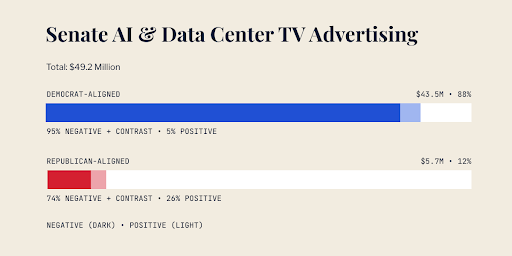
Advertisers spent $49.2 million on SI and data center TV ads in nine Senate races since September 7, according to AdImpact (Ohio, Texas, North Carolina, Michigan, Maine, Iowa, Alaska, Georgia, and Kansas). Democrats have won eight of these nine races, with Alaska too close to call.
- Democratic-aligned sponsors account for 88% of the money spent.
- Of that spending, Republicans were attacked in 95% of the ads that aired.
- Ohio ($29.9 million) and Texas ($14.2 million) accounted for 90% of the spend.
- In Ohio, 94% of the spending was negative against Senator Jon Husted, who became the top scalp for Democrats weaponizing the politics of data centers and AI.
The dynamic was so concerning in Ohio that the National Republican Senatorial Committee (NRSC) put out a memo in mid-August begging hyperscalers to come to Husted’s defense on the issue.
The House Spend
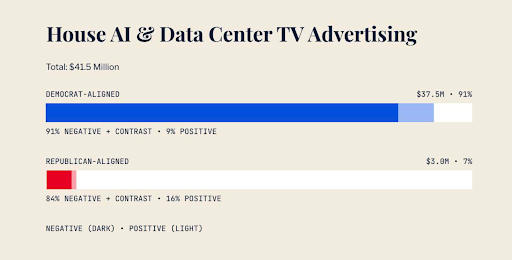
Advertisers spent $40.5 million on SI and data center TV ads in 25 House districts since Sept. 7, according to AdImpact.
- Democratic-aligned and independent groups spent $37.5 million, 84% of all House spending, attacking 20 Republicans.
- The most targeted were Tom Barrett in MI-07 ($5.5 million), Derek Van Orden in WI-03 ($5.1 million), Mariannette Miller-Meeks in IA-01 ($3.7 million), Jay Feely in AZ-01 ($3.5 million), Derek Merrin in OH-09 ($3.1 million), and Mike Lawler in NY-17 ($2.9 million).
- As of publication, four of these six candidates have officially lost, and the other two being Jay Feely and Tom Barrett, are trailing as results are still pending.
- No congressional district received more than 17% of spending.
More importantly, this spending was strategic in nature and driven by the upper echelons of the Democrats’ political apparatus. As The Hill noted in October, “Thirty-one out of the DCCC’s 69 ‘redboxes,’ which lay out potential messaging in key races, mention GOP candidates’ prior support for data center tax incentives, as well as investments in and contributions from developers of the controversial AI infrastructure.”
The Bottom Line: Democrats won most of the House and Senate races where they prioritized weaponizing SI politics against Republicans. In some cases, Democrats even effectively tied their opponents to tech leaders who benefit financially from the technology, such as spots hammering Republicans for aligning with David Sacks as he blocked SI regulation. In all of these races, GOP candidates and their allies failed to adequately counter these Democrat attacks.
THE ROAD AHEAD FOR REPUBLICANS
SI wasn’t the only reason for the major GOP losses we saw earlier this week, but it did play a significant role. NBC’s exit poll showed “that “56% of voters called artificial intelligence and data centers a crucial or major factor in their vote for Congress.” And while 2026 may have been the first SI election, it sure won’t be the last.
In 2028, the anti-elite economic populism we saw take root in both parties this cycle will only be exacerbated by presidential primaries on both sides of the aisle. This phenomenon, coupled with the continued global tech boom and continued voter angst about their personal future economic prospects, will continue SI’s rapid ascent up the issue grid. It is all interconnected. By the time ballots are cast in the early states two Januarys from now, SI will likely be the top voter concern.
We’re already seeing potential 2028 Democrat presidential candidates making tech and SI a priority. As Axios reported last week:
“Among 21 Democrats named as potential 2028 contenders, tech mentions on X nearly quadrupled, and press release mentions nearly tripled since the start of the year. Tech is now the second-most common topic in releases, trailing only jobs and the economy, with the highest concentration of mentions around data centers and phone bans in schools.”
And it seems the SI fights of the next cycle will center far more on overall regulation as opposed to just data center politics. As Axios noted last week, fresh Democrat internal polling shows “voters are more concerned about efforts to block state AI regulation than they are about data center controversies.”
It would be political malpractice for Republicans not to course correct their SI policy positions and risk permanently ceding this emerging issue to Democrats. But what can we do? We should support measures that protect American workers, kids, and national security. Voters made it clear this cycle that they do not believe Washington is doing enough to look out for them. We should answer with measures that ensure that SI is built in a way that Americans trust.
Protect the most vulnerable in our society. Technology should empower parents and protect children. We must pass legislation to ensure that chatbots never addict children, create unhealthy attachments, or coach children towards sexual behavior or suicide.
Defend our national security. We should codify President Trump’s SI Accord and build on it with a clear public incident reporting process, embedded government auditors, investigations into serious incidents, and strong accountability for reckless development practices.
Secure a flourishing economy. SI offers incredible potential to strengthen our economy, but we must not undermine our human dignity or burden American families. As we integrate it throughout the economy, we must implement measures that prevent workers from being left behind and require data center companies to pay their own way on power costs.
Ensure the benefits reach everyday Americans. Most Americans don’t trust this technology because they haven’t experienced tangible benefits. We should encourage SI developers to spend more resources on curing diseases and making products cheaper, and less on experiments that only benefit the developers themselves.
Not only are these ideas sound policies, they are smart politics. They will begin to change the perceptions of SI that motivated votes against Republicans this cycle and will be essential to earning back the trust we clearly lost as a party on SI over the last year. That trust in SI, which will be the top issue of 2028, will lead us out of the political wilderness where we find ourselves.
About the Alliance for a Better Future: Alliance for a Better Future is making sure America leads the world in AI by having AI that is worthy of our highest principles and values. ABF advocates for AI governance that is transparent, accountable, and worthy of the American people’s trust. Learn more at betterfutureai.org.
###
https://betterfutureai.org/media/press-releases/election-impact-2026/